What Rive Gauche Actually Means
If you have spent any time reading about Paris, you have almost certainly come across the term Rive Gauche. Translated directly from French, it simply means “Left Bank.” The Seine River flows through the heart of Paris from east to west, and when you stand facing downstream, the left side of the river is the south. That southern stretch of the city is the Rive Gauche. The right side, the north, is the Rive Droite, or Right Bank.
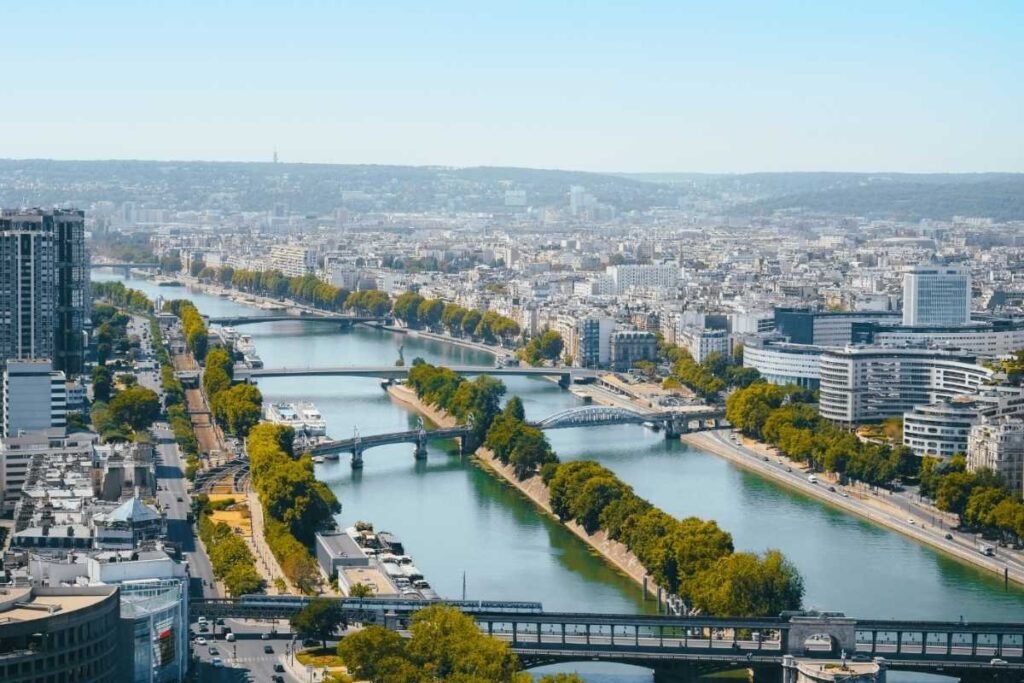
The confusion for many visitors is that “left” and “right” are determined by the direction the river flows, not by the way you happen to be standing on a bridge. Face east toward the river’s source and the Left Bank is on your right. Face west toward the river’s mouth and it is on your left. Once you understand that the Seine’s current sets the reference point, the whole system clicks into place and navigating Paris becomes far more intuitive.
Geographically, the Rive Gauche covers the 5th through 15th arrondissements, taking in neighborhoods like Saint-Germain-des-Prés, the Latin Quarter, Montparnasse, and the area around the Eiffel Tower. It has long carried a reputation as the intellectual and artistic heart of the city, home to the Sorbonne, the Musée d’Orsay, and the legendary cafés where Hemingway and Sartre once spent their afternoons. That reputation still holds in 2026, even if the café prices have changed considerably.
How the Two Banks Shape a Seine River Cruise
Understanding the Rive Gauche and Rive Droite distinction pays off enormously when you are on the water. A Seine cruise is essentially a moving tour that passes monuments on both banks in sequence, and knowing which side you are looking at helps you anticipate what is coming next and choose the best seat on the boat.
On the Left Bank side, you will spot the Musée d’Orsay with its grand arched windows, the Institut de France with its distinctive dome, and the tree-lined quays of the Latin Quarter. On the Right Bank, the Louvre’s long facade stretches along the water, and the Tuileries Garden leads your eye toward Place de la Concorde. The Notre-Dame Cathedral sits on the Île de la Cité, an island in the middle of the river, meaning it belongs to neither bank strictly speaking, which is part of what makes it feel so central to Parisian identity.
If you want to make sense of both banks in one go, a Paris Seine River sightseeing guided cruise with a live English and French guide is one of the most efficient ways to do it. A knowledgeable guide will point out which monuments sit on which bank and give you the historical context that transforms a pleasant boat ride into something genuinely educational.
For a more atmospheric experience, timing matters as much as knowledge. The Rive Gauche looks particularly striking in the late afternoon when warm light catches the stone facades along the quays. A Seine River cruise at sunset offers one of the best views of both banks as the city shifts from day to evening, with the golden hour making the Musée d’Orsay and the Institut de France glow in a way that photographs simply cannot fully capture.
For a longer evening on the water that lets you absorb both banks at a relaxed pace, a dinner cruise on the Seine River keeps you out on the water well into the night, giving you multiple passes along the illuminated quays of both the Left and Right Banks as Paris lights up after dark.
Practical Tips for Using This Knowledge on the Ground
Before you board any cruise, spend a morning walking along the Quai de la Tournelle on the Rive Gauche side. This stretch between the Pont de la Tournelle and the Pont de Sully gives you a ground-level sense of the Left Bank’s character and a clear view across to the Île Saint-Louis. You will understand the river’s orientation far better after walking it than after reading about it.
When booking a cruise, ask about seating arrangements if you have a specific bank you want to face. On most Seine boats, seating rotates naturally during the journey, but on open-deck cruises you can usually position yourself. If the Rive Gauche monuments are your priority, opt for a seat on the starboard side heading west from the Pont d’Iéna area, which is the standard starting point for most central Paris cruises.
One last practical note: the French pronunciation of Rive Gauche is closer to “reev gohsh” than anything an English speaker might guess from the spelling. Using even a rough approximation when asking locals for directions will get you much further than pointing at a map and hoping for the best.